Learn More
p21 Mouse, Unlabeled, Clone: SXM30, BD
Description
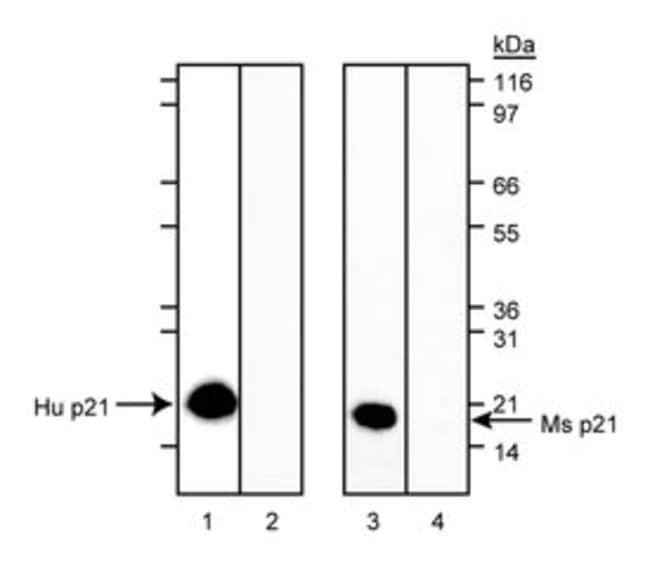
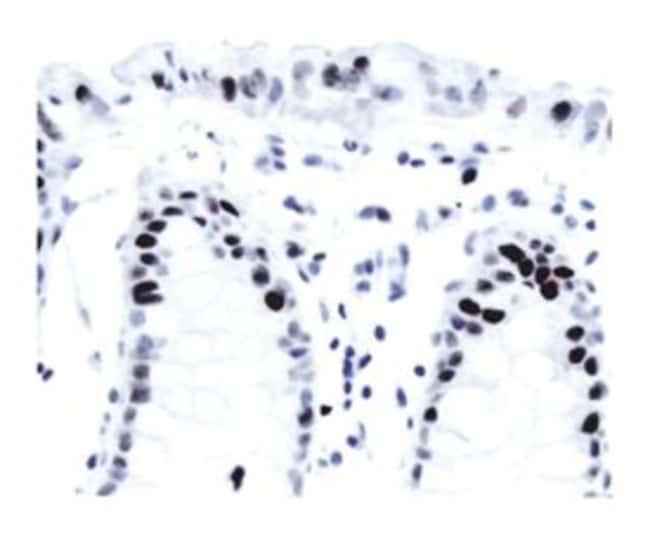
Cyclins and cyclin-dependent kinases (cdks) are evolutionarily conserved proteins that are essential for cell-cycle control in eukaryotes. Cyclins (regulatory subunits) bind to cdks (catalytic subunits) to form complexes that regulate the progression of the cell cycle. The activity of these complexes is modulated by activating and inhibitory phosphorylation events, as well as by interactions with small regulatory proteins including, p16, p21, p27, and others. These proteins, referred to as inhibitors of Cdk activity (CdkIs), bind to cyclins, cdks or their complexes. p21, also known as senescent cell-derived inhibitor 1 (Sdi1), wild-type p53-activated fragment 1 (Waf1), Cdk-interacting protein 1 (Cip1), and p53-regulated inhibitor of Cdks (Pic1) inhibits cyclin D-cdk4, cyclin E-cdk3, cyclin A-cdk2, and cyclin A-cdk1. p21 can also inhibit cell cycle progression by binding to PCNA and blocking DNA replication. p21 has also been shown to be a component of active cyclin-cdk complexes, suggesting that p21-containing complexes may shift between active and inactive states through changes in p21 content. Active, p21-containing complexes appear to contain one p21 molecule, whereas inactive compexes contain multiple p21 molecules. The expression of p21 can be induced in response to number of signals, including transcriptional upregulation by the tumor suppressor protein, p53. Human p21 has a calculated molecular weight of 18kDa and runs at 21kDa in SDS-PAGE. Clone SXM30 reacts with human, rat, and mouse p21. With regard to cross-species recognition, SXM30 has similar properties to a related p21 clone, SX118. Purified, recombinant human p21-fusion protein was used as immunogen.
Host Species: Mouse
Clone: SXM30
Isotype: IgG1 κ
Species Reactivity: Human, Mouse, Rat
Immunogen: Human p21
Immunofluorescence, Immunohistochemistry (Frozen), Immunohistochemistry (Paraffin), Immunoprecipitation, Western Blotting

Specifications
Specifications
| Antigen | p21 |
| Applications | Western Blot |
| Classification | Monoclonal |
| Clone | SXM30 |
| Concentration | 0.5mg/mL |
| Conjugate | Unconjugated |
| Formulation | Aqueous buffered solution containing ≤0.09% sodium azide. |
| Host Species | Mouse |
| Immunogen | Human p21 |
| Purification Method | Affinity Purified |
| Show More |
For Research Use Only.
By clicking Submit, you acknowledge that you may be contacted by Fisher Scientific in regards to the feedback you have provided in this form. We will not share your information for any other purposes. All contact information provided shall also be maintained in accordance with our Privacy Policy.