Learn More

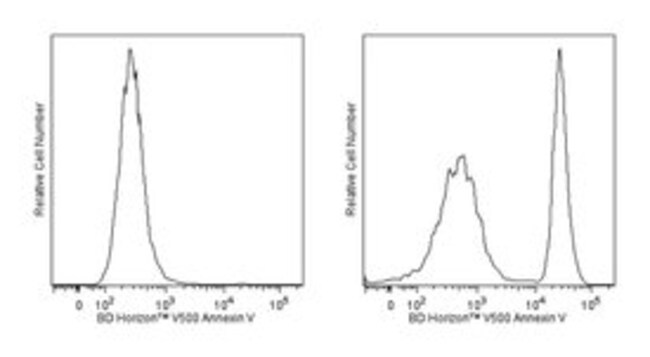
Annexin V anti-Human, V500, Clone: V500, BD
Description
Apoptosis is a normal physiologic process that occurs during embryonic development as well as in maintenance of tissue homeostasis. The apoptotic program is characterized by certain morphologic features, including loss of plasma membrane asymmetry and attachment, condensation of the cytoplasm and nucleus, and internucleosomal cleavage of DNA. Loss of plasma membrane is one of the earliest features. In apoptotic cells, the membrane phospholipid phosphatidylserine (PS) is translocated from the inner to the outer leaflet of the plasma membrane, thereby exposing PS to the external cellular environment. Annexin V is a 35-36 kDa Ca2+ dependent phospholipid-binding protein that has a high affinity for PS, and binds to cells with exposed PS. Annexin V may be conjugated to fluorochromes including BD Horizon™ V500. This format retains its high affinity for PS and thus serves as a sensitive probe for flow cytometric analysis of cells that are undergoing apoptosis. Since externalization of PS occurs in the earlier stages of apoptosis, V500 Annexin V staining can identify apoptosis at an earlier stage than assays based on nuclear changes such as DNA fragmentation.
V500 Annexin V staining precedes the loss of membrane integrity which accompanies the latest stages of cell death resulting from either apoptotic or necrotic processes. Therefore, staining with V500 Annexin V is typically used in conjunction with a vital dye such as propidium iodide (PI) or 7-Amino-Actinomycin (7-AAD) to allow the investigator to identify early apoptotic cells (PI negative, V500 Annexin V positive). Viable cells with intact membranes exclude PI, whereas the membranes of dead and damaged cells are permeable to PI. For example, cells that are considered viable are both V500 Annexin V and PI negative while cells that are in early apoptosis are V500 Annexin V positive and PI negative, while cells that are in late apoptosis or already dead are both V500 Annexin V and PI positive. This assay does not distinguish between cells that have undergone apoptotic death versus those that have died as a result of a necrotic pathway because in either case, the dead cells will stain with both V500 Annexin V and PI. However, when apoptosis is measured over time, cells can be often tracked from V500 Annexin V and PI negative (viable, or no measurable apoptosis), to V500 Annexin V positive and PI negative (early apoptosis, membrane integrity is present) and finally to V500 Annexin V and PI positive (end stage apoptosis and death). The movement of cells through these three stages suggests apoptosis. In contrast, a single observation indicating that cells are both V500 Annexin V and PI positive, in of itself, reveals less information about the process by which the cells underwent their demise.
When compensating dyes in this spectral range (such as Horizon™ V500 and AmCyan), the most accurate compensation can be obtained using single stained cellular controls. Due to spectral differences between cells and beads in this channel, using BD CompBeads can result in spillover errors for V500 and AmCyan reagents. Therefore, the use of BD CompBeads or BD CompBeads Plus to determine spillover values for these reagents is not recommended. Different V500 reagents (e.g. CD4 vs. CD45) can have slightly different fluorescence spillover therefore, it may also be necessary to use clone specific compensation controls when using these reagents.

Specifications
Specifications
| Antigen | Annexin V |
| Applications | Flow Cytometry |
| Classification | Monoclonal |
| Clone | V500 |
| Conjugate | Violet Fluor 500 (V500) |
| Formulation | Aqueous buffered solution containing BSA and ≤0.09% sodium azide. |
| Purification Method | Affinity Purified |
| Quantity | 50 Tests |
| Regulatory Status | RUO |
| Primary or Secondary | Primary |
| Show More |
By clicking Submit, you acknowledge that you may be contacted by Fisher Scientific in regards to the feedback you have provided in this form. We will not share your information for any other purposes. All contact information provided shall also be maintained in accordance with our Privacy Policy.